If you’ve just started learning programming, you’ve probably noticed that getting your code to work feels like a huge achievement. But writing code that works is only half the job. The other half is making sure your code is easy to understand, update, and debug later. That’s where clean code tips for beginners come in.
The good news is that writing clean code isn’t something reserved for experienced developers. You can build good habits from day one, and those habits will make you a better programmer as you continue learning.
What Is Clean Code?
Clean code is code that is simple, readable, and easy to maintain. It helps both you and anyone else who reads your code understand what it does without spending extra time figuring it out.
Think of it like writing a well-organized notebook. You can quickly find information because everything is clearly labeled and neatly arranged.
Here’s what clean code usually looks like:
- Easy to read
- Well organized
- Uses meaningful names
- Avoids unnecessary complexity
- Easy to modify later
Even if you’re working on small practice projects, writing clean code will save you time.
Why Beginners Should Care About Clean Code
Many beginners focus only on making their programs run. While that’s understandable, messy code becomes difficult to fix as projects grow.
Imagine building a calculator today. A month later, you decide to add scientific functions. If your original code is disorganized, adding new features becomes frustrating.
Learning clean coding early helps you:
- Find bugs faster
- Learn programming concepts more clearly
- Work better in teams
- Build projects that are easier to improve
- Prepare for professional software development
Good coding habits are much easier to build now than later.
Use Meaningful Variable and Function Names
One of the most important clean code tips for beginners is choosing descriptive names.
Instead of this:
a = 15
b = 5
c = a * b
Write this:
length = 15
width = 5
area = length * width
The second example immediately tells you what each value represents.
The same rule applies to functions.
Instead of:
def calc(x, y):
Use:
def calculate_total_price(price, quantity):
Descriptive names reduce confusion and make your code almost self-explanatory.
Keep Functions Small and Focused
Every function should perform one specific task.
Avoid writing one giant function that handles everything from user input to calculations and printing results.
For example, instead of one large function, split it into smaller ones:
def get_user_input():
    pass

def calculate_total():
    pass

def display_result():
    pass
Smaller functions are:
- Easier to test
- Easier to debug
- Easier to reuse
- Easier to understand
Whenever a function starts becoming too long, ask yourself if it can be divided into smaller pieces.
Write Helpful Comments, Not Obvious Ones
Comments should explain why you’re doing something, not simply repeat what the code already says.
Avoid comments like this:
Add two numbers
total = a + b
The code already makes that clear.
Instead, write comments that explain decisions.
 Apply a discount for premium members
total *= 0.9
A good comment provides useful context.
Remember, clean code should mostly explain itself through clear naming and organization.
Keep Your Formatting Consistent
Formatting may seem unimportant at first, but it makes a huge difference in readability.
Follow consistent spacing and indentation.
Bad formatting:
if(x>10):
 print("Large")
Better formatting:
if x > 10:
    print("Large")
Consistent formatting helps your eyes scan code quickly.
Most modern code editors can automatically format your code, so take advantage of that feature.
Avoid Repeating the Same Code
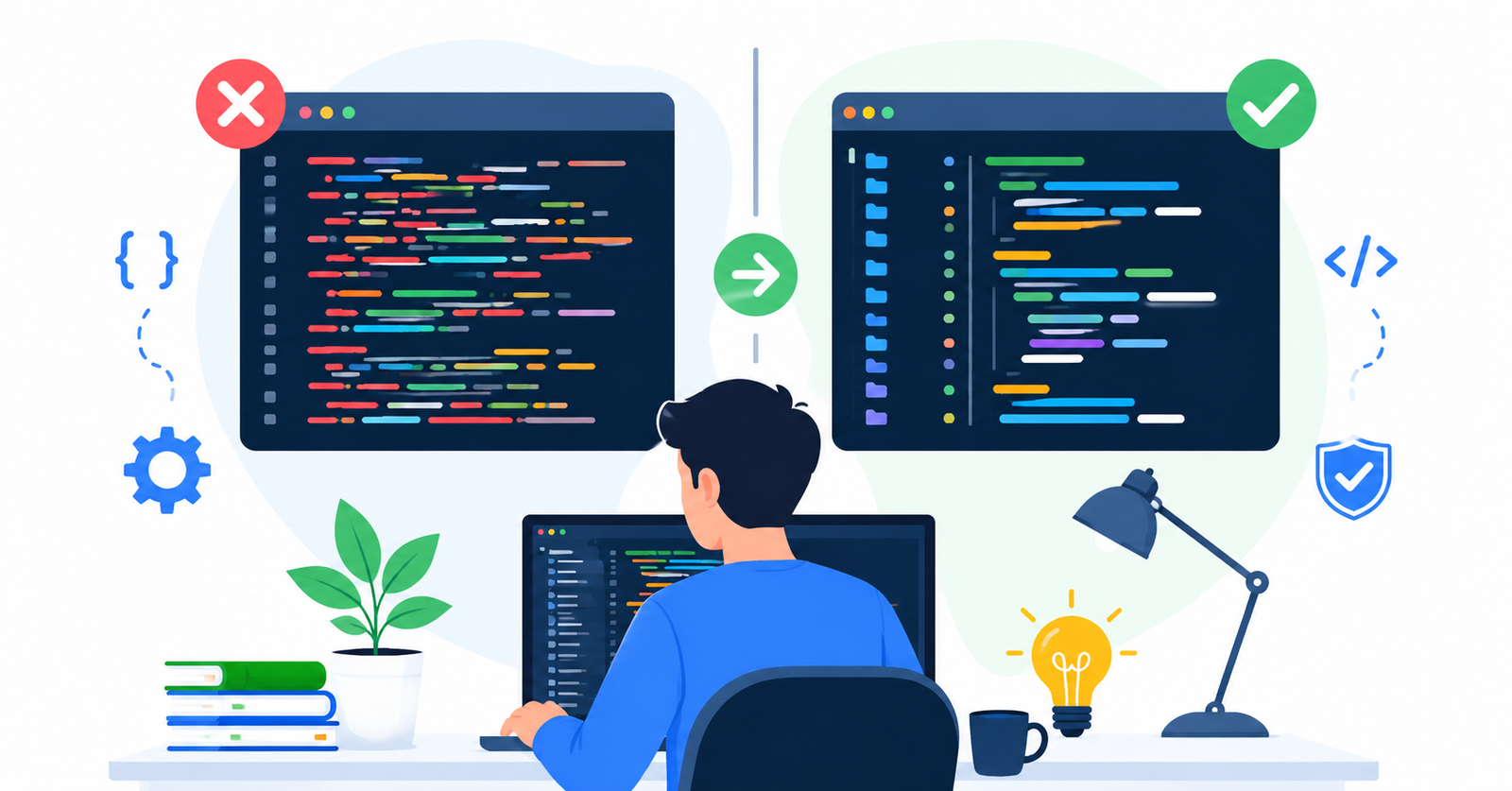
Another valuable clean code tip for beginners is following the DRY principle—Don’t Repeat Yourself.
Suppose you need to calculate tax several times.
Instead of repeating:
price = price + (price * 0.18)
Create a function:
def add_tax(price):
    return price * 1.18
Now you can reuse the function anywhere.
This makes updating your program much easier because changes happen in only one place.
Use Simple Logic Whenever Possible
Many beginners try to impress themselves by writing clever one-line solutions.
Simple code is almost always better.
Instead of squeezing everything into one complicated statement, break it into smaller steps.
Readable code is easier to debug and maintain.
Remember, programming is about solving problems—not writing puzzles.
Organize Your Code Properly
As your projects grow, keeping everything in one file becomes difficult.
Start organizing your work into sections.
For example:
- Import statements
- Constants
- Helper functions
- Main functions
- Program entry point
Even in beginner projects, this structure makes navigation much easier.
If your language supports multiple files, gradually learn how to separate related code into different modules.
Test Your Code Often
Clean code isn’t just about appearance.
It’s also about reliability.
Instead of writing hundreds of lines before testing, check your program after every small change.
For example:
- Write one function.
- Test it.
- Fix any problems.
- Move to the next function.
This approach saves hours of debugging later.
Many experienced developers spend less time fixing bugs simply because they test frequently.
Learn to Refactor Your Code
Refactoring means improving code without changing what it does.
Suppose your program works perfectly.
Now ask yourself:
- Can I simplify this?
- Can I rename variables?
- Can I remove duplicate code?
- Can I split large functions?
Refactoring helps transform working code into clean code.
Professional developers regularly revisit old code to improve its quality.
Don’t think of your first version as the final version.
Common Mistakes Beginners Should Avoid
Here are some habits worth avoiding:
- Using single-letter variable names everywhere
- Writing extremely long functions
- Copying and pasting code repeatedly
- Ignoring indentation
- Mixing unrelated tasks in one function
- Leaving unused code inside projects
- Writing comments for every single line
Avoiding these mistakes makes your projects look much more professional.
Build Clean Coding Habits One Project at a Time
You don’t have to master every clean coding practice immediately.
Instead, focus on improving one habit with each project.
For example:
- This week, improve variable names.
- Next week, write smaller functions.
- After that, reduce repeated code.
Small improvements add up surprisingly fast.
Over time, you’ll naturally begin writing cleaner programs without even thinking about it.
Final Thoughts
Learning programming is about much more than getting the correct output. Writing clean code helps you think more clearly, solve problems faster, and create projects you’ll actually enjoy revisiting later.
The best part is that clean coding isn’t difficult. It simply requires paying attention to readability, organization, and simplicity. Every project you build is an opportunity to practice these habits. Start with meaningful names, keep functions small, avoid unnecessary repetition, and test your work regularly.
Your future self—and anyone who reads your code—will appreciate the effort. Try applying these clean code tips for beginners in your next project, and notice how much easier your code becomes to understand and maintain. If you discover a tip that improved your coding style, share it in the comments and help other beginners learn too.