If you’ve ever wondered how to start a career in coding with no experience, you’re not alone. Many successful software developers began with zero programming knowledge, no computer science degree, and no professional experience. The good news is that the tech industry values skills more than traditional qualifications, making coding one of the most accessible career paths today.
The journey may seem overwhelming at first, but with the right learning plan, consistent practice, and a willingness to build projects, you can go from complete beginner to job-ready developer.
Can You Really Become a Developer Without Experience?
Absolutely.
Many companies hire junior developers based on their skills, portfolio, and problem-solving ability rather than years of experience.
What employers usually want to see is:
- Practical coding skills
- A strong portfolio
- Basic understanding of programming concepts
- Ability to learn independently
- Good communication skills
Your first goal shouldn’t be landing a job immediately. Instead, focus on becoming someone who can solve real programming problems.
Step 1: Choose One Programming Language
A common beginner mistake is trying to learn several programming languages at once.
Instead, choose one language and master the basics first.
Good beginner-friendly choices include:
- Python – Great for beginners, automation, AI, and data science.
- JavaScript – Essential for web development.
- Java – Popular for enterprise applications and Android development.
- C# – Excellent for desktop software and game development.
Python is often recommended because its simple syntax makes learning easier.
Example:
python id="y4f8ws" name = "Alex" print("Welcome to coding,", name)
Learning one language thoroughly builds a strong foundation for learning others later.
Step 2: Learn the Fundamentals
Before building large projects, understand the basics.
Focus on topics like:
- Variables
- Data types
- Conditional statements
- Loops
- Functions
- Lists and dictionaries
- File handling
- Object-oriented programming
Don’t rush through these concepts.
Understanding the fundamentals will make advanced topics much easier.
Step 3: Practice Every Day
Consistency is one of the biggest factors in becoming a successful programmer.
Even 30 to 60 minutes of daily coding is more effective than studying for several hours only once a week.
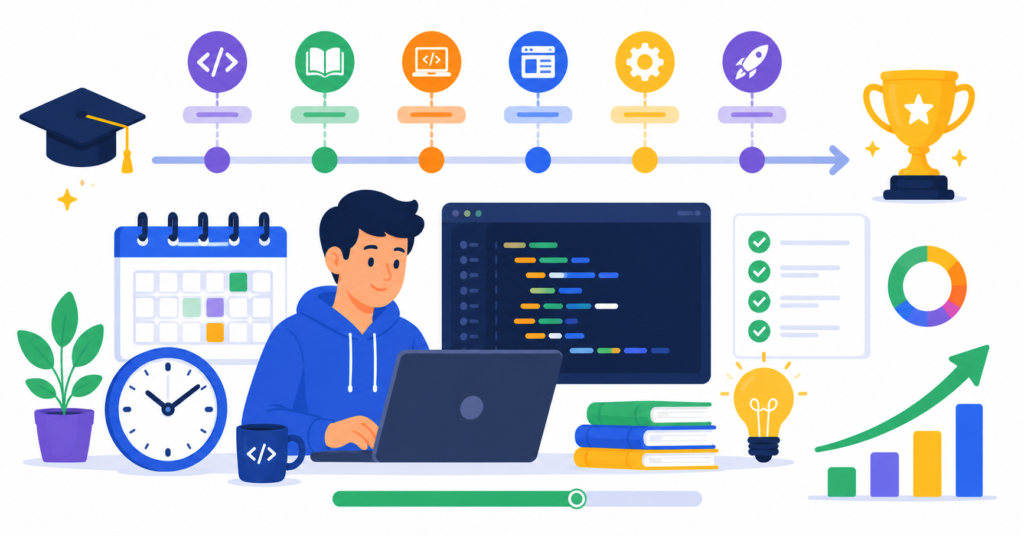
Try creating a simple schedule:
- Monday – Learn a new concept.
- Tuesday – Practice coding exercises.
- Wednesday – Build a mini project.
- Thursday – Review previous lessons.
- Friday – Solve coding challenges.
- Weekend – Improve your projects.
Small daily progress adds up quickly.
Step 4: Build Real Projects
Projects are what transform knowledge into experience.
Instead of only watching tutorials, create applications using what you’ve learned.
Beginner-friendly ideas include:
- Calculator
- To-do list
- Weather app
- Quiz game
- Expense tracker
- Personal portfolio website
- Password generator
Each project teaches something new and gives you something valuable to showcase later.
Step 5: Learn Git and GitHub
Version control is an essential skill for every developer.
Git helps you track changes in your code, while GitHub lets you store projects online and collaborate with others.
Even simple projects look more professional when they’re available on GitHub.
Recruiters often review GitHub profiles before scheduling interviews.
Step 6: Create a Portfolio
A portfolio demonstrates what you can build.
Include:
- Personal introduction
- Programming skills
- Completed projects
- GitHub profile
- Contact information
Your portfolio doesn’t need dozens of projects.
Five well-built projects are often more impressive than twenty unfinished ones.
Step 7: Practice Problem Solving
Coding isn’t only about writing syntax.
It’s about solving problems.
Spend time on coding challenge websites practicing:
- Arrays
- Strings
- Loops
- Functions
- Algorithms
- Logic puzzles
Regular practice improves both confidence and interview performance.
Step 8: Learn How to Read Documentation
Many beginners rely only on video tutorials.
Professional developers constantly read documentation.
Learning how to understand official documentation helps you:
- Solve problems independently
- Learn new libraries faster
- Become less dependent on tutorials
This habit becomes increasingly valuable as your skills grow.
Step 9: Join the Coding Community
Programming becomes easier when you connect with other learners.
Join:
- Online coding communities
- Developer forums
- Programming Discord servers
- Local coding meetups
- Open-source communities
Helping others and asking questions accelerates your learning.
You’ll also discover new tools and opportunities through networking.
Step 10: Prepare for Your First Job
Once you’ve built several projects, start preparing for interviews.
Review:
- Programming basics
- Data structures
- Algorithms
- Problem-solving questions
- Basic system design
- Git and GitHub
Practice explaining your projects clearly.
Interviewers often care as much about your thinking process as your final answer.
Common Mistakes to Avoid
Many beginners slow their progress by making avoidable mistakes.
Try not to:
- Jump between multiple programming languages.
- Watch tutorials without practicing.
- Copy code without understanding it.
- Compare yourself to experienced developers.
- Give up after encountering bugs.
- Skip building projects.
Remember, every developer started as a beginner.
Mistakes are simply part of the learning process.
Stay Patient and Keep Learning
A coding career doesn’t happen overnight.
Some learners find their first opportunity within a few months, while others take longer.
The important thing is to remain consistent.
Every project, coding challenge, and bug you solve brings you one step closer to becoming a professional developer.
Progress may feel slow from day to day, but over months, the improvement is remarkable.
Final Thoughts
Learning how to start a career in coding with no experience is less about finding shortcuts and more about following a clear path. Choose one programming language, master the basics, build practical projects, create a portfolio, and practice coding consistently. These habits will help you develop the skills employers are looking for, even if you don’t have a formal degree or previous job experience.
Most importantly, don’t let your lack of experience stop you from getting started. Every professional programmer wrote their first line of code at some point. Begin with small projects, keep improving every week, and stay curious. Your coding journey starts with a single step, and the best time to take that step is today. If you’re beginning your programming journey, share your goals in the comments and inspire others to start as well.